 Passer au contenu
The case of voice over awards
In this article
· Serious clients cast by ear, not by trinklets
· Awards: a validation that strokes the ego
· The desire for recognition: a vanity trap?
· Networking opportunities
· How to make awards truly valuable
The voice over awards. It's fantastic. Why is it fantastic? I'll tell you all about it.
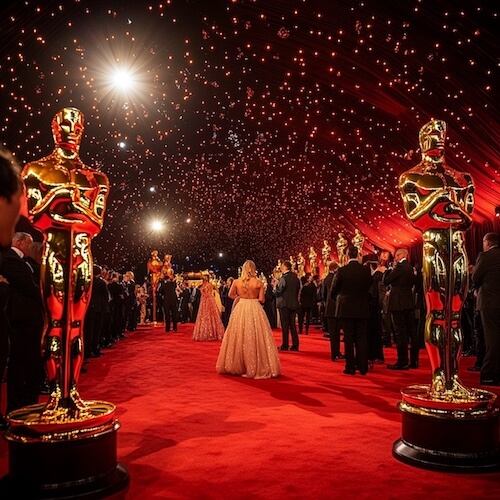
 The awards. Every French voice actor, English, American (or any nationality) voice actor, has in mind these glamorous ceremonies where everything sparkles, with big chandeliers and lots of gilding, where the women wear sumptuous evening gowns (often with vertiginous cleavage), where the men generally wear tuxedos (often without vertiginous cleavage), with stars who are sometimes a little drunk, and speeches that are sometimes funny, sometimes touching, sometimes provocative... Beyond the spectacle, they guarantee the nominees and winners bums on seats, increased exposure and contracts.
Well, the voice over awards are a bit different. In over 30 years in the business, I've never heard of a serious client - ad agency, production company, agent, casting director, TV channel - who cares about awards. How on earth do they know if a voice actor is good, or if it matches their casting? They use a tool that's hundreds of thousands of years old: their ears and their brains. Isn't that crazy?
(I talk about the casting process in the article Voice over casting: things to do, mistakes to avoid)
All right, the voice over awards don't put food on the table for voice actors. But the red carpet, the glitzy stuff, the champagne, the applause - you've got to admit, it's a thrill. Awards feed our sometimes fragile egos, and respond to the natural and constant quest for validation that is part and parcel of being human, and there's nothing wrong with a self-hug. Awards also feed a whole little industry that lives off the people for whom that validation is important - but everyone's gotta eat, right?
The voice over awards also offer a significant opportunity for those who take part (and who, in many cases, have paid for the privilege) to post on social media that they have been nominated or have won an award. Perhaps even with a photo of them in a posh frock, alongside other equally well-dressed people. Let's be honest, a posh frock is pretty cool. And if they win, they can buy the trophy, which, on the mantelpiece or a shelf, will be the topic of conversation at dinner parties: "Our friend is a star!" When you like to be the centre of attention, it's always a bonus. And even if you're not a narcissist, we all appreciate words of encouragement or compliments. After all, there's nothing wrong with a with a little self-care, right?
 Of course, as mentioned above, potential customers couldn't care less about awards, often preferring good old-fashion casting by ear. But these awards allow the nominees and winners to showcase their work on Linkedin to their colleagues that people who are sometimes very competent, sometimes who don't have much in their portfolio but who make a lot of noise on social media, have appreciated their work - and that's better than nothing, right? As for the others, those who weren't nominated, who didn't win anything, the simple fact of taking part makes them feel like a winner winner, chicken dinner. Wearing a posh frock in a glamorous venue tends to have that effect. High five!
And above all, these ceremonies allow voice actors, who often work alone without much social interaction with others in the business, to have a drink (or several) at the bar with colleagues. And that, my friends, is a huge bonus. No, seriously. Huge.
But how do you make the voice over awards even more fantastic?
Of course, these awards could be even better. For example, if they simply celebrated the best work produced, selected by real authorities in the sector, judged by recognised heavyweights in the business (veteran voice actors, voice directors, agents, copywriters, creative directors, producers, sound engineers, etc.) In short, luminaries with a solid, consistent and verifiable career path, giving them unquestionable legitimacy. Then, and only then, could voice over awards be recognised by the major players in the industry (advertising agencies, production companies, TV channels, etc.) as a kitemark standard. It wouldn't change the fact that casting would still be done by ear, but at least it would give the thing some weight. They could be sponsored by manufacturers or suppliers linked to the voice over trade. But Rome wasn't built in a day, was it?
 My name is Pierre Maubouché. I've been a full-time French voice actor for over 30 years. It's my only source of income. I have voiced hundreds of TV adverts and corporate films, I've been the continuity voice of several networks, the promo voice for many others, I've taken part in dozens of video games... I've had a real and verifiable career (for a small sample of my work, I invite you to go to the page presenting my voice over work or visit my Youtube voice over channel). And I have something to confess: I've never won a voice over award - the fact that I've never applied for one probably didn't help, I admit, but I'm a bit of a hermit, and I don't need one for my promotion, my work's enough for that.
But when voice over awards have credibility in the industry, when they are useful beyond cajoling the bank accounts of organisers and the egos of participants, who knows? Only fools never change their minds, and every day I try to be less stupid (often I fail, but I'm stubborn). And I like a tipple. Or few. Shall we meet at the bar?
This article presents my opinion, which some people don't share, and that's fine. Some colleagues claim that their award has opened doors for them, and I have no reason not to believe them - local or regional advertisers working directly with voice actors, unfamiliar with our industry, may be impressed. Another undeniable advantage is the networking opportunities. The colleagues you meet at these ceremonies can be a valuable source of advice. In short, there’s a lot on the table. And champagne!
To discuss the topic with your colleagues, be sure to share it with them on your social media. I invite you to comment on this article, and if you have any questions, I'll do my best to answer them!
PS: by subscribing to this voice over blog, you will have exclusive access to new articles before they are officially published. It's free so make the most of it, go ahead and subscribe now !



 by

Hello Pierre! Great post!
I thought I'd comment as I completely agree with your sentiment of aiming to provide 'The kitemark standard' of voiceover awards. I think at the One Voice Awards we have done just that - please allow me to explain...
The OVA's were created in 2018 because we felt that monetising voice actors for awards was not ok, and there were no other options available at the time.
To do this and achieve the nirvana state you mention, we made the entries completely free, and made it completely free if you win. Although the ticket price for the awards evening show is paid, you don't have to attend, and we will post you the award at our own cost if you win. Point of fact, the OVAs always make a financial loss for us, but it's our way of giving back to the industry.
All entries are made completely anonymously (and we redact the notes before going to judges), the judges identity is kept a secret until the awards night (so no one can ask for votes), the judges do not know who the other judges are (so cannot confer) and the judges do not see any other judges scores (so cannot be influenced). These factors mean that the voting is done purely on the merit of each clip and so a fair voting structure is obtained.
Because of this - what you have with the OVA's is ... Integrity.
That integrity over time has built trust with the audience and the industry as a whole.
You also mention the pedigree of the judges: Our judges are always from long-standing voice artists with good reputation, usually 25 years + in the industry, we have casting directors, agents, people who work and hire at the BBC, Channel4/E4, the larger radio stations, independent broadcasters - with the sole aim to provide a fair, balanced and prestigious panel of judges who bring weight to the proceedings. We strive for diversity in the judges and ....yes....the awards are only sponsored by key manufacturers who work in the voiceover trade.
Couple that with the sheer number of entries we now receive each year (4000+ last year and in both the UK and the USA awards) and you can understand that the standard of shortlisted entries is incredibly high.
These factors are why the OVA's are sell-out shows each year, and why people are so happy to post pictures & updates of their wins....because even if it's true that some hirers don't care whether they have won an award, the artists themselves most definitely DO care that their work matters....that their contribution to the artform has had an effect....and that they are recognised among their peers as having been outstanding in their field in an industry in which we are so often alone....
Thank you for the post - and I hope I have managed to illustrate why I think the One Voice Awards is already the fantastic goal that you are hoping for!
Hugh Edwards
CEO GFTB & One Voice
You’re welcome, Hugh! Your comment sounds like an OVA advert, and I can’t blame you – we’ve all got a business to run, after all! Of course GFTB profits from OVA, and it should; you’re not running a charity, and you need to earn a living. I fully acknowledge that OVA is a step in the right direction compared to other awards and ‘services’ that prey on aspiring or naive voice actors, selling them the goose that lays the golden eggs.
I really do appreciate you taking the time to comment on this article. I welcome and encourage all opinions on my blog. I believe that we can only make things better if we have an open and honest debate, rather than the code of silence that is all too common, particularly in our industry, where so many people are worried that speaking their mind will affect their chances of getting work.
Thank you for pointing out that not all awards are equal, and for explaining the specific nature of the OVA. I won’t comment on the legitimacy of the judges or the award winners, as that is a matter of opinion. I am sure that some of the judges are highly respected, genuine heavyweight industry experts, and I know for a fact that some of the nominees and winners are worthy of their peers’ acclaim.
As I see it, the flaw is inherent in all awards as they are currently structured: only those who enter are considered. And often, people who enter do so because they believe it will benefit their business, or to boost their self-confidence and seek validation, or out of narcissism, or because they think it will be their ticket into some exclusive old boys’ club. And why not? After all, some of that might well be true. But these people are not always representative of the most outstanding players in their field, as voice actors who are successful in their careers do not necessarily feel the need to enter. I do not claim to have a ready-made solution for this; it is simply an observation.
I do this job because I love it and I’m good at it (no imposter syndrome here). But my main aim is to feed my children and pay the mortgage. Accreditation schemes are only useful if they’re recognised as the gold standard across an entire industry, and if they bring in customers or put food on the table – and so far, that hasn’t been the case. We don’t need our peers’ opinion to know our worth: genuine agents representing us, clients providing us with properly paid work – that’s how we know what we’re really worth. Of course, let’s be honest, it’s nice to be recognised – but personally, putting food on the table for my children is more important than feeding my ego.
Where do we go from here? Perhaps by setting up a panel comprising respected, esteemed experts; industry icons; long-established, top-tier voice-over agency owners and bookers; recognised directors; senior production executives from networks and leading production and games companies; owners of high-end recording studios and sound engineers, and in-demand voice actors – not competing in the contest but with a current, legitimate, recognisable, verifiable and substantial body of work – could having this panel select work from existing, published or broadcast material be part of the solution? Just thinking out loud here; I’m sure there are many other things that could be done. If you’d like, I’d be happy to continue this conversation – and who knows? One day I might even enter the competition, strange things and all!